Ancient Pavement
Split, Croatia
Discover the Ancient Pavement of Peristyle Square in Split, Croatia—a 1,700-year-old Roman marvel blending history with vibrant modern life.
Overview
Stepping onto the Ancient Pavement within Peristyle Square in Split, Croatia, is akin to walking through 1,700 years of unbroken history. This magnificent courtyard, the central and most impressive public space of Emperor Diocletian's Palace, is far more than just a beautifully preserved stone floor; it is the very heart of a living monument, a UNESCO World Heritage site where ancient Roman grandeur seamlessly intertwines with contemporary life. The pavement itself, crafted from durable local and imported stone, has borne witness to centuries of imperial decrees, medieval life, and modern-day gatherings, offering a tangible connection to the past for every visitor. It's a place where the echoes of time are almost palpable, framed by towering columns and historic buildings, inviting contemplation and wonder.
History & Cultural Background
The story of the Ancient Pavement begins in the late 3rd and early 4th centuries AD, as part of Emperor Diocletian's ambitious retirement palace. Built between 295 and 305 CE, the palace complex was designed to be both a luxurious personal retreat and a fortified military stronghold. The Peristyle, with its distinctive pavement, served as the formal northern access to the emperor's private apartments and was the ceremonial focal point of the entire complex. It was here that Diocletian, revered as the living son of Jupiter, would make public appearances, with subjects approaching him in ceremonial fashion, often kneeling in deference. The architectural style reflects a masterful blend of Roman and Greek influences, characterized by symmetry, balance, and ornate details. The columns, many of them made of red granite shipped from Aswan, Egypt, dramatically frame the space, highlighting its imperial significance. The primary construction materials, including white limestone from the nearby island of Brač and other imported marbles, speak to the palace's original opulence and the extensive resources at Diocletian's command.
What Makes It Special
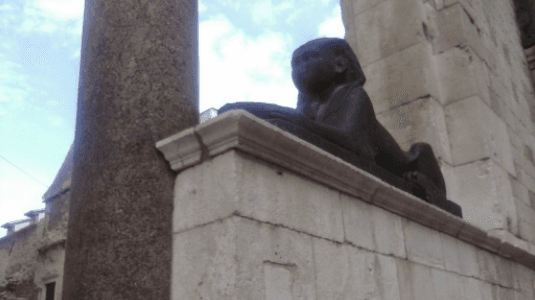
The remarkable aspect of the Ancient Pavement in Peristyle Square lies not just in its age, but in its continuous, vibrant use for over seventeen centuries. Unlike many Roman ruins that stand as archaeological sites, this pavement is an active stage for daily life, cultural events, and social interaction. It is a testament to the ingenious adaptation of ancient structures by subsequent generations. The grandeur of the square is further enhanced by its surrounding elements: massive Corinthian columns, the impressive Cathedral of Saint Domnius (originally Diocletian's mausoleum), and the venerable Temple of Jupiter. Perhaps one of its most unique features is the ancient black granite sphinx, approximately 3,500 years old, brought from Egypt by Diocletian himself, which silently guards the square, connecting Split not only to Roman history but also to an even more ancient civilization. The blend of Roman, medieval, and even Renaissance architecture from surrounding buildings leaning into the ancient structure creates a unique visual tapestry that is rarely seen elsewhere.
Stories, Fun Facts & Local Details
The Ancient Pavement is steeped in stories and local charm. Imagine the solemn processions and imperial pronouncements that once unfolded on these very stones. The red color of the granite columns was deliberately chosen to emphasize the ceremonial function, as purple, from which the granite takes its hue, became the imperial color after Diocletian's reign. A delightful modern tradition involves visitors and locals alike taking a seat on cushions placed on the ancient steps surrounding the Peristyle, enjoying a coffee or drink while soaking in the timeless atmosphere. This blend of ancient setting and casual contemporary life is a truly unique experience. The square's exceptional acoustics make it an ideal venue for a variety of cultural events, especially during the summer, hosting concerts, theatrical performances, and traditional 'klapa' singing groups, whose harmonies resonate beautifully off the ancient walls. Pope John Paul II, deeply moved by the enduring history of the place, is said to have remarked, 'Dear God, how many feet have stepped through here,' a sentiment shared by many who traverse its hallowed ground.
Visitor Perspective
For the curious traveler, walking on the Ancient Pavement of Peristyle Square is an immersive journey through time. It's a sensory experience: the smooth, worn marble underfoot, the sunlight playing off the ancient stones, and the sounds of bustling modern life mingling with the distant echoes of history. Early mornings or late evenings offer a magical ambiance, often quieter, allowing for a more reflective experience and stunning photographic opportunities as the square glows under soft light. The Peristyle serves as a central hub, providing access to other significant sites within Diocletian's Palace, including the impressive Cathedral of Saint Domnius with its bell tower, which offers panoramic views of Split. Whether you're admiring the intricate details of the Roman architecture, gazing at the Egyptian sphinx, or simply sitting on the steps watching the world go by, the Ancient Pavement of Peristyle Square offers a profound connection to the layered history and enduring spirit of Split. It's a place where every step tells a story, making it an unforgettable highlight of any visit to Croatia.
Coordinates: 16.440176, 43.508369
View on Google Maps💬 How Travelers Describe This Place
Based on community votes
Unique
996Photogenic
673Beautiful
585Interesting
143Must See
69
Traveler Stories
Discover memorable experiences shared by travelers who have visited this place.
No traveler stories yet.
Be the first traveler to share what made this place memorable.

Tour
By
Spot
Discover amazing places around the world. Your journey starts here.
Explore
© 2026 TourBySpot. All rights reserved.