Agora
Antalya, Turkey
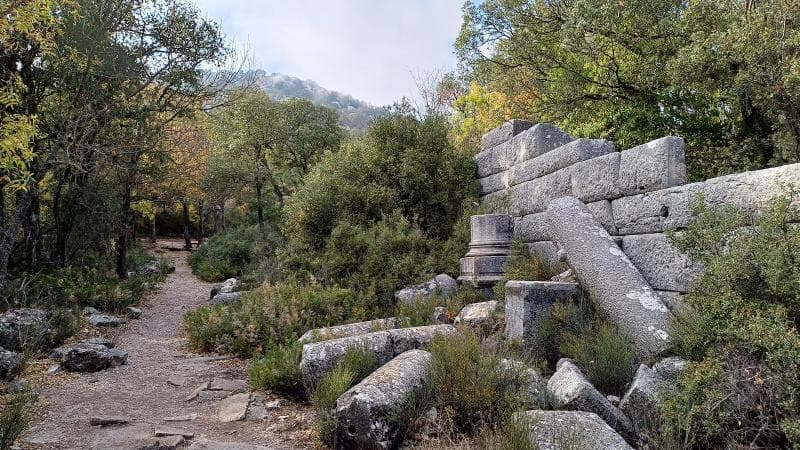
Explore the ancient Agora of Termessos in Antalya, Turkey. Discover the historical heart of this 'Eagle's Nest' city high in the Taurus Mountains.
Overview
High in the dramatic Taurus Mountains, approximately 30 kilometers northwest of Antalya, Turkey, lies the ancient city of Termessos, a site often referred to as the 'Eagle's Nest'. Within its rugged embrace, the Agora stands as the vibrant heart of what was once a thriving Pisidian settlement. Perched at an altitude of over 1,000 meters, Termessos offers not only breathtaking panoramic views but also an extraordinary glimpse into an ancient civilization that defied even Alexander the Great. The city is celebrated as one of Turkey's best-preserved ancient sites, intertwined with dense pine forests within the Güllük Dağı National Park, and is currently on the UNESCO World Heritage Tentative List.
The Agora, the central public space, was more than just a marketplace; it was the social, political, and economic epicenter of Termessos. Its unique design, featuring a raised platform and surrounded by impressive stoas, reveals the sophisticated urban planning of its inhabitants. Exploring this historic square allows you to connect with the daily lives of the Termessians, imagining the bustling trade, philosophical debates, and community gatherings that once animated this remarkable mountain city.
History & Cultural Background
The history of Termessos is as imposing as its mountainous location. Founded by the Solymi, an ancient people believed to be descended from Luvis, the city quickly established a reputation for its fierce independence. Its strategic position made it a formidable stronghold, so much so that in 333 BC, Alexander the Great, attempting to conquer the city, famously withdrew, calling it an 'eagle's nest' and deeming it too difficult to capture. This act of defiance became a defining moment for Termessos, showcasing the resilience and determination of its people. The city maintained its autonomy throughout much of its history, even being granted independent status by the Roman Senate in 71 BC, a testament to its formidable strength and strategic importance.
The Agora itself flourished during the Hellenistic and Roman periods, evolving as the city integrated into the wider Greek and then Roman world while retaining its distinct Pisidian identity. The grand stoas that frame the Agora are particularly noteworthy, reflecting the city's alliances and internal prosperity. The two-storey stoa on the northwest side, for instance, was a generous gift from Attalos II, King of Pergamon, between 150-138 BC, solidifying a bond of friendship. Later, a wealthy local, Osbaras, constructed the northeastern stoa, likely in imitation of Attalos' grand gesture, during the Roman period.
What Makes It Special
The Agora of Termessos is truly special due to its exceptional state of preservation and its dramatic setting. Unlike many ancient cities found on flat plains, Termessos's elevated location amidst untouched natural beauty gives its Agora a unique, atmospheric quality. The blend of ancient architecture with the wild, forested landscape creates a sense of profound tranquility and timelessness. It feels less like a meticulously excavated museum and more like a discovery waiting to be made.
Beyond its aesthetic appeal, the Agora's architectural elements tell compelling stories. The ground floor, raised on stone blocks, indicates a thoughtful design, perhaps to mitigate the mountain's uneven terrain or to elevate its importance. Moreover, the presence of five large, unique cisterns hollowed out to the northwest of the Agora highlights the ingenious solutions Termessians devised for water management in their high-altitude city. These cisterns are not merely functional but are a testament to the advanced engineering capabilities of the ancient inhabitants.
Stories, Fun Facts & Local Details
Imagine the Agora during its prime: a cacophony of voices, the scent of spices and goods, and the vibrant exchange of ideas. It was here that the heart of Termessian society beat strongest. While specific stories from the Agora are sparse, its proximity to other significant structures paints a vivid picture. Nearby, the grand theatre, overlooking the Pamphylian plain, would have hosted plays and public gatherings, its audience perhaps spilling over into the Agora area before and after performances.
A fascinating detail is the inscription found on Attalos II's stoa, explicitly stating it was a 'proof of his friendship' to Termessos. This simple phrase captures the political dynamics and the value placed on alliances in the ancient world. Another intriguing aspect is the mention of a heroon, a hero's tomb, once located on the Agora, though the hero's identity remains a mystery. This suggests the Agora was also a place of veneration, intertwining civic life with heroic narratives.
Visitor Perspective
Visiting the Agora at Termessos today is an experience that transcends a typical archaeological tour. The journey to Termessos itself, through the Güllük Dağı National Park, is an adventure, with trails winding through lush pine forests. Upon reaching the Agora, you are met not with meticulously reconstructed facades, but with authentic, unrestored ruins where nature has begun to reclaim its territory. This provides a raw, immersive experience.
Wandering through the remnants of the stoas and envisioning the vast square where so much life once unfolded offers a powerful connection to the past. While some structures, like the gymnasium nearby, are hard to discern due to tree growth, the overall impression is one of discovery. The quiet solitude of the site, far from the bustling coastal resorts of Antalya, allows for deep contemplation. It's a place to ponder the enduring spirit of a people who chose freedom and built their city in defiance of nature's challenges and imperial might, leaving behind a legacy carved into the mountain itself.
Coordinates: 30.46472, 36.9825
View on Google Maps💬 How Travelers Describe This Place
Based on community votes
Interesting
898Photogenic
667Beautiful
618Must See
449Unique
308
Traveler Stories
Discover memorable experiences shared by travelers who have visited this place.
No traveler stories yet.
Be the first traveler to share what made this place memorable.

Tour
By
Spot
Discover amazing places around the world. Your journey starts here.
Explore
© 2026 TourBySpot. All rights reserved.